Tuesday, April 14, 2009

Recession Increasing Insurance Fraud

Does a bad economy increase crime? Analysts have debated that question for years, according to Mike McKee, senior special agent for the National Insurance Crime Bureau. While it's too soon for statistics to confirm whether recent events like the mortgage meltdown and an increase in unemployment truly lead consumers to commit more crimes, McKee said at least anecdotally the economic recession is affecting insurance fraud.

"The special agents at NICB have been seeing some effect from the current economic situation on insurance fraud," McKee said. Additionally, he said the recession is affecting fraud enforcement efforts in several ways. "One, it's siphoning off investigators. For example, the FBI is aligning a lot more investigators to look into actual economic fraud investigations versus insurance fraud investigations. All of the bank problems, mortgage fraud, things like that are detracting from the investigations of fraud."

The Coalition Against Insurance Fraud is seeing an uptick in different types of fraud such as auto giveups and arson, said Howard Goldblatt, director of government affairs. "Fraud bureaus are telling us this, we're hearing it from the state fire marshals, and we're hearing about it anecdotally through news stories. It's clear that as the economy has gone down, the opportunity to commit fraud, to recover monies they think they need, has increased."

And with anywhere from $80 billion to $200 billion lost to fraud each year, affecting all lines of the insurance business — health, property, casualty, life and disability — it's no wonder that states are concerned with combating it.

Cashing in on Cars
Typically, insurance fraud is more prevalent in large, metropolitan areas. Large states such as California, Florida, New York and Texas also see more than a normal amount of fraud, McKee said. Yet across the nation, from Louisiana to California, insurance departments report they've seen an increase in vehicle giveups, where the owner alleges that a vehicle theft has taken place, but in reality the owner has gotten rid of the vehicle.

"When the owner is involved, they'll often report the car stolen but actually take it out to the desert and set it on fire, then go back home and call the police, collect the insurance money, then pay off the car and make a profit," McKee said. "Here in California, we've got a lot of waterways where they drive it into the water and just sink the vehicle."

In some cases, with vehicle sales down and dealerships closing, another trend NICB sees occurring in Nevada and California is car dealership fraud. In this case, employees of car dealerships sometimes facilitate the theft and/or burning of vehicles to help the car owner pay off their old car and, in turn, have them purchase a new one from the dealership.

"CNN reported on March 17, 2009 that in the 4th quarter of 2008, 9 percent of all auto loans were one or more payments behind," McKee said.

In California, John Standish, bureau chief for the fraud division, southern region at the California Department of Insurance, said staged accident rings are increasing. Criminal rinks are finding it easier to recruit alleged victims for insurance scams because of people being in dire straits, needing money and not having the capability to function, he said.

Personal Assets
When people are in economic straits, they also try to unload other valuable assets, such as classic cars or jewelry. New Hampshire's Fraud Unit Director Barbara Richardson said her state's Insurance Division has seen tons of jewelry go lost or missing in recent months.
Cindy Schmell, fraud bureau chief for the Iowa Division of Insurance, said her department has seen an increase in arson of both vehicles and homes.

"Desperate consumers also are torching homes — seeking an insurance bailout from foreclosure or general financial distress," McKee added. And, in California, he said the NICB has seen a "tremendous increase in alleged smoke and ash cleanup, where three to six months after the wildfires, people are coming in and saying, 'I had to spend thousands of dollars to cleanup my house for this ash and smoke.'"


The Top Ten Insurance Myths You Need to Know!

Umbrella Insurance is only for the rich. I am alive so I need Life Insurance, right? My co-worker is uninsured and that doesn't effect my insurance. Learn why these insurance myths are inaccurate and find out answers to the top 10 insurance myths everyone should know.

Myth #1: Insurance Should be Bought and Used for Every Disaster

Insurance is designed to protect one from catastrophic disasters. An insurance rule of thumb: If you can pay for the loss or damage without a financial hardship then pay it, otherwise expect your insurance premium to eventually show an increase. Also, buying every type of insurance just isn't necessary. Sometimes the risk is worth taking rather than paying a premium.

Myth #2: If I am Alive, I Must Need Life Insurance!

Life insurance is designed to take care of one's dependants after the caregiver's death. If you have no dependants, then you probably don't need life insurance. This includes children and retired persons... usually they don't have people that depend on their income so life insurance for these groups can, in rare instances, be beneficial but is usually unnecessary.

Myth #3: I'm the Breadwinner in the Home, So Only I Need Life Insurance.

Have you seen the cost of childcare lately? Add that along with housekeeping, food preparation, home accountant, and school transportation. From that list alone one can see how much a spouse really contributes to the household budget. It is estimated a non-working spouse contributes at least, but usually more, the equivalent of a full time job. For this reason it is important to buy life insurance for everyone in the household if the absence of their income would cause a financial hardship.

Myth #4: Whole & Universal Life are the Best Since I Can Get My Money Back

Term life insurance is probably the best choice for most. Term life is set for a specific term, like 10-30 years, with a much lower premium than whole and universal life. Your best bet? Buy term life and invest the premium difference in a retirement account.

Myth #5: Flood Insurance is Only for People Who Live in a High Risk Area.

Everyone who lives in a National Flood Insurance Program area is eligible and can buy flood insurance. These areas are not always prone to floods so even if you think your area is low risk you may be eligible. Check with your insurance agent to learn more.

Myth #6: Our Insurance Will Cover My Son When He is Delivering Newspapers

If your vehicle is used for anything but personal use, then you will probably need to extend your personal auto policy to cover business use of your vehicle. Don't think just because you were unaware of your coverages this will get your accident paid for--your insurance policy is a contract that you agreed to adhere to. If you don't understand all the coverages in your contract you need to contact your agent about the questions you have.

Myth#7: I Don't Need Disability Insurance Because I can Get Social Security.

Don't count on Social Security to take care of all your needs if you become disabled. If you are able to get Social Security for your disability (not all get approved to receive disability benefits so don't assume you will) then you will still have to wait months before you receive benefits and your disability needs to be long-term to qualify. And even if you qualify for benefits, will it match your current salary? Probably not.

Myth #8: If I Need Nursing Care When I am Older, The Government Will Pay for it.

Again, don't count on Medicare or Medicare Supplemental Insurance to pick up the bill. If you can qualify, Medicaid may pay up to half of the cost. Choosing long term care insurance can help you pay for the costs of a nursing facility or home care if the need arises. Also, do you really want your family to have to pick up the bill if you acquire a long term illness or disability? Long Term Care Insurance is a great option and if started early in life the premiums can be very reasonable.

Myth #9: Umbrella Insurance Coverage is Just for Rich People.

Umbrella insurance is not just for the wealthy. With the common occurrence of lawsuits, umbrella insurance is a must for every home, auto, and watercraft owner. Umbrella insurance is designed to give one added liability protection above and beyond the limits on homeowners, auto, and watercraft personal insurance policies. With an umbrella policy, depending on the insurance company, one can add an additional 1-5 million in liability protection.

Myth #10: If I Don't Purchase Health Insurance it Won't Affect Others.

People who don't purchase health insurance eventually affect the lives of every American. When many people in a company choose not to purchase health insurance, it sends a message to the employer that health insurance may not be an important benefit, which in-turn could cost other workers a loss of their health insurance benefits. Also, when healthy people don't buy health insurance, the costs raise for others because the risk is spread through less people. For these and other reasons, many have encouraged the government to switch to a universal health care system where the government would help manage health care.

Weekend Insurance Tip: Know What to Do After a Car Accident

Although car accidents are more prevalent in the winter months, what you need to do after an accident never changes. Obviously it is hard to think clearly after a car accident so it is important to know before you get into an accident what to do first and what questions may need answered. This checklist will help you know what to do after a car accident. It is best to review it now and then print it out and keep a copy with you in your car.

Uncovering The Secrets Of Getting California Health Insurance To Pay For Autism Treatments

Autism is a neurobiological condition which is often responsive to Applied Behavior Analysis (ABA) therapy, yet most health insurance companies fail to provide this medically necessary service to their members. For the past 7 years, AB 88, known as the Mental Health Parity Act, has been on the books in California. This piece of legislation obliges private health insurance companies to offer treatment services for enrolled members who are diagnosed with autism; but actually getting health insurance to pay for these interventions is a challenge. Up to this point, the advocacy movement to enforce this law has been relatively quiet. Most parents find that insurance companies are not willing to cooperate or give coverage for autism without a fight. To date, there are at least 15 cases in the state that have gone through the full process of request, denial, appeal, and independent medical review (IMR) resulting in families with autistic children receiving insurance funding for intensive ABA services.

Wellspring is eager to assist families through this process, which if successful will provide families with options for treatment as well as alleviating the Regional Center of some of the burden of responsibility for funding of such services.

Wellspring is excited to announce a free seminar for parents that want to use their health insurance to pay for autism treatments. The featured speakers are Dr. Karen Fessel and Feda Almaliti, who have successfully secured private insurance for the funding of autism treatment for their children.

Karen Fessel, Dr PH

Autism Parent and Advocate

Karen Fessel is the proud parent of a 14 year old son with Asperger's, and a 10 year old typical daughter. Karen has a Doctorate in Public Health from UC Berkeley. She has served as a parent advocate on the Autism Advisory Workgroup. She fields questions on an insurance help website, and serves on the Special Ed Advisory Committee of the Lafayette School District. Karen has filed and won several complaints and IMRs against three different insurance companies. Many families have benefited from Karen's personal guidance and have secured insurance coverage for their child's treatment.

Feda Almaliti

Autism Parent and Advocate

Feda Almaliti is the proud parent of 3 boys ages 4 through 10. Her youngest son was diagnosed with autism at 18 months, and since then she has fought tirelessly to get him the help he needs. Recently she fought and won an IMR that resulted in Kaiser paying for 26 hours of ABA, 2 hours of speech therapy, and 2 hours of occupational therapy, weekly. Feda's battle with Kaiser has been featured on local ABC and CBS news stations. Feda is dedicated to helping other parents because "It is the parents who have helped and supported me in my journey through autism."

Their presentation will be invaluable to families who have private insurance and who would like to pursue their insurance carrier for the vital health care supports that their autistic children need. This team has lead parents in some of the biggest wins in the state of California related to autism: securing 40 hours a week of ABA paid by insurance!

MetLife Won’t Seek Capital Injection From Treasury

MetLife Inc., the largest U.S. life insurer, said it won’t seek funds from the Treasury’s Capital Purchase Program after announcing last month it may participate.

The insurer “has already taken actions to reinforce its strong financial position,” Chief Executive Officer Robert Henrikson said today in a statement. “MetLife is well positioned, with approximately $5 billion in excess capital.”

MetLife is seeking to distinguish itself from rivals including Hartford Financial Services Group Inc. and No. 2 Prudential Financial Inc., which turned to the Treasury after losing money in 2008. New York-based MetLife, which raised $2.3 billion in October selling stock at $26.50 a share, has remained profitable by hedging against market declines.

MetLife gained 20 cents to $28.99 at 5:02 p.m. in late New York trading following the news release. MetLife has dropped 17 percent this year on the New York Stock Exchange compared with the 30 percent slide at Hartford and 4.3 percent drop at Newark, New Jersey-based Prudential.

Banks and savings and loan companies that accepted government funds have bristled under the scrutiny of lawmakers, who criticized firms for their compensation and lending practices. Life insurers are waiting for Treasury’s reply after at least 12 requests for aid, some of which came as many as five months ago.

Goldman Sachs

Goldman Sachs Group Inc., the sixth-biggest U.S. bank, said today it’s planning to raise $5 billion in a share sale as it seeks to repay Treasury $10 billion the firm received last year.

The federal financial bailout program, originally designed to buy soured loans from banks, has become a tool for the Treasury to bolster firms including credit-card companies and carmakers. The Standard & Poor’s Supercomposite Life & Health Insurance Index has declined 26 percent this year, making it more difficult for firms to raise cash from private investors.

MetLife said in its annual report in March that the company was eligible to apply for an investment from the U.S. because it owns a bank. Taking cash from the government would lead to “restrictions on our business,” the filing said.

MetLife has benefited from federal aid in the sale of $397.4 million in bonds backed by a guarantee from the Federal Deposit Insurance Corp. in March. The insurer has also sold short-term debt to the government under the federal commercial paper program.

Stress Test

MetLife, one of the top 19 banking institutions in the U.S., is “working closely” with the Federal Reserve in the government’s review of balance sheets at the country’s biggest lenders, the insurer said in the statement.

U.S. life insurers, which as a group lost $32 billion in surplus in 2008, were instructed by Treasury last year to buy banks or savings-and-loan institutions to qualify for TARP funds. The applications of eligible insurers will be reviewed and funded on “a rolling basis,” Treasury said last week.

Life insurers have reported losses and profit declines as the financial crisis pushes down the value of investments backing policies and annuity guarantees. Prudential and Hartford each lost more than $1.7 billion in the second half of 2008, while MetLife’s profit exceeded $1.5 billion.

Attempts to reach Henrikson through spokesman Christopher Breslin weren’t successful.


Microsoft Visual Basic 6 Advanced

Microsoft Visual Basic 6 is a versatile language, usable for business applications, database interface, gaming applications, and even for presentations.

In the Visual Basic 6 Advanced tutorial, Professor Arthur Lee will take your Visual Basic skills to the next level by showing you multiple form projects, code for multiple forms, sequential forms, and much more.

Download ( MBs):
Code: http://rapidshare.com/files/23162866...Basic6_Adv.rar

Microsoft Visual Basic 6

Microsoft Visual Basic 6 is a versatile language, usable for business applications, database interface, gaming applications, and even for presentations.

Professor Arthur Lee authors this tutorial. He begins by introducing code and the controls needed in Visual Basic. Learn all about variables, debugging, and creating menus, as well.


Download (about 26MBs RARed)
Code: http://rapidshare.com/files/27222655/VisualBasic6.rar

Microsoft Visual Basic .NET

Author - Mark Long / Certified Instructor
Total Time - 6 Hours

Microsoft Visual Basic has evolved throughout the years, but has steadily remained one of the most popular programming languages today. Visual Basic .NET is undoubtedly the most significant change to occur to Visual Basic yet. Significant new features include: unity of programming models, extension of the program to include mobile device capabilites, Performance Counters and Server Explorer, flashy new capabilities in Windows Forms, anchoring controls, opacity and transparency properties, and much more.

In this six hour tutorial, Microsoft Certified Instructor Mark Long will introduce and expand upon Microsoft Visual Basic .NET and what users can do with it.

Download (86 MBs):
Code: http://www.megaupload.com/?d=UD4VV3MZ

MS Visual Studio .NET

With it's powerful WYSIWYG editor for Web designs, HTML IntelliSense and Style Sheet Editor, Visual Studio.net makes it simple for developers to create solutions spanning any Internet device.

Author Dave Mercer teaches developers how to harness the power of this powerful Internet application builder that allows for the targeting of operating systems and languages. Choose from a host of modernized languages and make use of the familiar syntax users of Visual Basic are familiar with, as well as the Object Oriented Programming power and inheritance features. Create and deploy server based logic. No more sifting through tedious code! Save on time and build scalable applications using reusable .NET user interfaces, databases, and server components.

Download (58 MBs):
Code: http://www.megaupload.com/?d=HIKACVTW

Introduction to Microsoft. NET Framework

Microsoft’s .NET Framework has revolutionized the way we build and use computer applications.

In the Introduction to the Microsoft. NET Framework, Certified Instructor Mark Long will use simplified explanations to introduce the viewer to the .NET technologies.
This course is recommended as a precursor to any other .NET courses.

Download (95 MBs):
Code: http://www.megaupload.com/?d=IOBQZ3OF

C + +

C Plus Plus (C++) is a programming language that is both procedure-oriented and object-oriented.

In this tutorial, Professor Arthur Lee will explain the environment of C++, then guide you into writing equations, creating functions and output, looping, and much more.

VTC C++ Programming Tutorial (14.5MBs)
Code: http://www.megaupload.com/?d=F282CDHP

C Programming

Virtual Training Company's C Programming tutorial is taught by an expert C programmer, Mark Virtue, who has been using C for over 15 years, and has been teaching C programming for over 5 years. Perfect for beginners, this tutorial starts at an introductory level, assuming that you have no prior programming experience.

The instructor takes you through the basic concepts and techniques of C, and gives you exercises with which he guides you through to get to the solutions. You will be taken smoothly into more advanced concepts, such as pointers and dynamic memory. If you are already familiar with programming, you can skip past what you already know.

VTC C Programming Tutorial (97.7MBs)
Code: http://www.megaupload.com/?d=NFOEPSB3

Introduction to the Java Programming Language

Java is a simple, scalable object oriented, general purpose programming language with a multitude of uses. With the power to develop everything from simple web animations to high-end business applications that program hand-held devices, microwaves, cross platform server applications and more, it's no wonder why Java is on everyone's mind.

This practical "how to" course by Java expert Arthur Griffith, starts from the beginning and uses practical examples to demonstrate the Java programming language.


Download (about 130MBs RARed)
Code: http://rapidshare.com/files/25491656...ntro.part1.rar
http://rapidshare.com/files/25534013...ntro.part2.rar

Saturday, April 4, 2009

First Drive Review: 2010 Ford Mustang GT

Nearly five years after the Mustang's last major redo, fervent fans of Ford's seminal pony car might have been hoping for an all-new 2010 model — especially considering the new Dodge Challenger and Chevy Camaro models with which it will compete. Instead, Ford has launched a thoughtful upgrade, improving the areas that most needed help.

Number one was the interior, which had a retro look but consisted of hard plastic panels pieced together with numerous seams. From behind the wheel, the most obvious change is an instrument panel that stretches from door to door and from the base of the windshield to the top of the center console. This thermoplastic olefin molding feels squishy and looks rich. The twin-cowl theme of the current car continues, but it's upgraded with more metallic trim and less plated plastic, a new instrument cluster with fully round dials, and an optional nav system with a huge, eight-inch screen and the latest version of the Ford/Microsoft Sync telematic system.

Outside, the new model is plainly a face lift rather than an all-new design, bearing a closer resemblance to the '69 Stang than the current car. The four-light grille — the inner two are actually large fog lights — and the kicked-up rear fender lines come straight from the '69 car. Otherwise, the sheetmetal is beveled at both ends, and there's a pronounced hood bulge — the new model looks both more muscular and a bit smaller than the current one, which in some ways seems like a cleaner and more coherent design.

The new skin, in combination with fairings under the engine, reduces drag by seven percent and front lift by 23 percent on the GT models we drove, according to Ford. And in the rear, each of the LED taillights has three separate elements that light up sequentially, as did the turn signals of certain vintage Thunderbirds.

Underneath, the 2010 model is largely carried over, with key additions to improve stiffness and upgrade the ride and handling. Using the current car's Bullitt package as the starting point, the new car gets 17 percent stiffer rear springs, and recalibrated shocks with markedly more compression damping and somewhat stiffer rebound damping. The changes are said to reduce body roll during hard cornering by about ten percent.

The V-8-powered GT now comes standard with 8 x 18-inch wheels (up from 8 x 17s), and the standard rubber is a Mustang-specific 235/50ZR Pirelli P Zero Nero all-season tire, a further development of the 17-inch Neros on the current GT. In Ford testing, these tires perform well in snow and deliver 0.84 g of dry cornering grip. Upgrading to 245/45ZR-19s mounted on 8.5-inch-wide rims raises grip to a claimed 0.90 g. The last GT we tested pulled 0.89 g on all-season Neros.

Ford finally is offering a TrackPack, which includes 255/40ZR-19 P Zero summer tires, stiffer shocks, higher-performance brake pads, a 3.73 axle ratio instead of a 3.31, rear trailing links with stiffer bushings, a strut tower brace, and larger anti-roll bars (the tubular 34mm front bar goes from 5.1 to 5.8 mm wall thickness and the solid rear bar increases from 20 to 24mm). With all of these changes, Ford says maximum grip increases to 0.93 g, while body roll is reduced a further ten percent.

The larger standard wheels and tires add only 15 pounds to the Mustang, which is a good thing because power hasn't gone up much. Thanks to a cold-air system based on that of the Bullitt Mustang, power is up from 300 to 315 horsepower, and torque grows a modest five pound-feet to 325. The redline is also up from 6250 to 6500 rpm, matching the Bullitt's. The cold-air system is said to cut 0-to-60 times by 0.3 second away from a stoplight, when the engine has been heat-soaking while idling at the light. The transmissions are unchanged with a choice of a standard five-speed manual or an optional five-speed automatic.

Driving Impression
We spent a couple of days driving both current and new Mustang GTs around Southern California and at Willow Springs Raceway, and we predict that most people could tell the two cars apart even if blindfolded. The subtle structural improvements, the recalibrated suspension, and the better integrated interior achieve a marked improvement in the car's perceived solidity. The current car is hardly a rattletrap, but the 2010 feels granite-like and is completely unfazed by hard driving or sharp bumps.

Depending on how you drive it, the new model is both quieter and louder than its predecessor. At low revs and light throttle, engine noise is subdued, and reductions in wind and road noise produce a peaceful cabin. Rev the engine, however, and you get the V-8 rap in high fidelity, thanks to something called a "sound induction tube," which connects the engine's intake track to the passenger cabin. There's a tuned membrane in the tube to transmit selected sound frequencies without actually permitting any airflow.

On California's smooth canyon roads, the new Mustang felt perfectly composed and planted. There was plenty of grip for brisk street driving and just enough understeer to encourage charging into corners and hard exits. Though feedback from the front tires is largely nonexistent, the steering itself is perfectly weighted and very accurate.

On the track, the differences among the three tire packages quickly became apparent. In all cases, the new Mustang understeers mildly at the limit but can easily be rotated with a quick throttle lift. But the speed at which this takes place goes up with the optional 19-inch Neros. Switching to the TrackPack yields not only another increase in grip but a chassis that turns in much harder and reacts more quickly to inputs at the limit.

For the first time, the Mustang offers stability control — Ford calls it "Advance­Trac" — and it's standard. The system allows substantial shenanigans before it decides to shut down the fun. A sport setting is even more permissive. The system on the TrackPack gets special tuning and to go bareback, the system can be switched off.

Unfortunately, there's no switch for bigger brakes. Even with the TrackPack pads, it didn't take many laps before the stoppers started to fade.

We didn't get the chance to drive any V-6 models, but they come with many of the same changes bestowed on the V-8s, with standard stability control and enlarged wheels with 17s standard and optional 18s. The 4.0-liter V-6 is unchanged with 210 hp and 240 lb-ft of torque and the same five-speed manual and automatic transmissions.

As usual, there is a wide range of options, but it's worth noting that prices have hardly increased for the new model. A base 2010 V-6 Mustang will go for $21,845, up $620, while a GT will cost $28,845 — up $840, which is not bad for a car that includes most of the hardware from the $3300 Bullitt package. Expect the Mustang faithful to be standing in line when deliveries start in March. The new convertible will arrive shortly afterwards.

Performance Data
PERFORMANCE (C/D EST, 5-sp man):

Zero to 60 mph: 5.0 sec
Zero to 100 mph: 12.3 sec
Standing ¼-mile: 13.6 sec @ 104 mph
Top speed (drag limited): 151 mph

PROJECTED FUEL ECONOMY (C/D EST):
EPA city driving: 15 mpg
EPA highway driving: 22-23 mpg

BMW 7 Series Ranked Most Tech-Advanced

BMW’s 7 Series has been named the world’s most technologically advanced new vehicle in 2009 according to iSuppli Corp's Technology Availability Scorecard.
"For the fourth consecutive year, BMW has taken the leading OEM position in iSuppli’s Technology Availability Index," said Phil Magney, vice president, automotive research, for iSuppli. "The updated version of the BMW 7 Series includes 30 of the 35 total features defined in iSuppli’s Technology Ranking—the highest score ever recorded for an individual model in the four years this ranking has been conducted."

The 7 Series is a technological cornucopia, with a new 80Gbyte Hard Disk Drive (HDD) multimedia navigation system, an updated iDrive interface, a second-generation night vision system, a traffic sign recognition system and blind-spot detection. The 7 Series also offers a variety of built-in wireless features including an industry-first Internet browser, premium traffic, High Definition (HD) and Satellite Radio, Bluetooth, and a Harman Kardon Logic 7 surround sound system.

BMW also took the No.-2 spot on the model ranking, with its 5 Series coming in close behind the 7 Series with a score of 28. The BMW 6 Series received a score of 27. The BMW X5, Lexus LS—the overall leader in 2006—and the Hyundai Genesis earned 25 points, while the BMW 3 Series, X6, and Toyota Crown received a score of 24.

Collectively, BMW has a larger number of technology features deployed across more of its models than any other OEM, thus putting it in the top position for the fourth straight year.

Maruti To Unveil Its 9th Small Car, Maruti Ritz, in May

Maruti Cars India is geared up for the launch of its brand new compact car Maruti Ritz, targeted at small urbane families. Maruti Ritz is designed on the lines of its globally successful model Maruti Splash.

Maruti Ritz IndiaMaruti India is contemplating to position the Maruti Ritz with the Maruti A-Star and the Maruti Swift. Maruti Ritz will counter Hyundai i10, Hyundai i20, Skoda Fabia, Ford Fusion, Fiat Palio and Tata Indica Vista. Maruti Ritz is Maruti's ninth car and the company aims to position it as the leader in the crowded market.

Maruti Ritz IndiaMaruti Ritz is equipped with BS-IV engines and a 5-speed manual gearbox. Maruti Ritz will be powered by 1.2L petrol engine and 1.3L multi-jet diesel engine.

Maruti Ritz IndiaThe all new Maruti Ritz will be priced between 4 to 4.5 lakh rupees. Having cleared all the homologation tests it was approved by the International Centre of Automotive Technology (iCAT) at Manesar in Haryana last week. The Maruti Ritz is all set for launch in the Indian market.

Maruti Ritz India

HP Firebird with VoodooDNA 803

HP's purchase of Voodoo has resulted in the past in an Editors' Choice–winning gaming rig, the Blackbird 002, and the Voodoo Envy 133 subnotebook. The latest system to come out of this union is the HP Firebird with VoodooDNA 803 ($2,099 list). A high-powered gaming desktop, it has some unique attributes. For one, the rig's insides have several notebook-like characteristics, including switchable graphics—the first we've seen on a desktop. For another, its styling is distinctive, yet it has an HP/Voodoo family resemblance. Unfortunately, there are a few issues that could keep it from winning over the hard-core gamer, such as some disappointments with performance and limited upgradability. Still, this is not your father's gaming desktop. And for the more casual part of the gaming market, that's a good thing.

Dell Announces Cheap Inspiron Desktops

The new Inspiron desktop line follows the Studio XPS line with a fresh design, including a range of eight colored faceplates available on both mini-tower and slim-form-factor desktops.

Dell introduced a new line of Inspiron desktops today with fashion in mind. The new Inspiron desktop line follows the Studio XPS line with a fresh design, including a range of eight colored faceplates. The eight colors are available on both mini-tower and slim-form-factor desktops, including a special "Promise Pink" ($5 per system sale will be donated to the Susan G. Komen foundation for breast cancer research and education).

Dell Inspiron Slim Desktop

The Inspiron line is customizable with a low $299 entry point. Custom choices include Intel Celeron, Core 2 Duo, and Core 2 Quad processors, as well as AMD Sempron, Athlon 2, and Phenom X4 processors. Integrated Intel and ATI Radeon graphics are standard, with discrete graphics as a custom option. These systems will support up to 8GB of memory and up to 750GB (slim) or 1TB (mini-tower) of hard drive space. Blu-ray drives will also be available; therefore, the price and capability range of the Inspiron line will be varied from low to high end.

The Inspiron slim and mini-tower desktops debut today in China though Dell.com and local retailers Suning and Gome. The Inspiron line will be available worldwide later this spring.

Microsoft Investigates PowerPoint Zero-Day Attack

Microsoft has released a security advisory for a vulnerability in some versions of PowerPoint, which has been exploited in the wild.

PowerPoint versions 2000, 2002, and 2003 are all vulnerable to attack by opening a malicious PPT file that exploits the vulnerability. Microsoft says that "limited and targeted attacks" have been seen in the wild. Office 2004 for Mac is also technically vulnerable, but an attack for it would have to be custom-written for the Mac.

As with many attacks in the past, the older Office file formats are at issue here, not the new ones. In fact, one mitigation users may take is to use MOICE (the Microsoft Office Isolated Conversion Environment), an add-on for earlier versions of Office that automatically converts old file formats into the new ones and uses them in that form. But the main advice is that not open files from untrusted sources.

If you think you may have been affected, which is unlikely because when Microsoft uses the term "limited and targeted attacks" it usually means that one or two attacks have been observes, you can scan your system with Microsoft's Windows Live OneCare safety scanner. The malicious PPT files are detected as Exploit:Win32/Apptom.gen.

Dell's Updated Vostro Laptops Offer Small Businesses Complete Videoconferencing Solutions

Dell introduces its newest Vostro laptops, designed expressly to meet small business needs, and custom-built to maximize productivity amidst shrinking travel budgets with free, pre-installed videoconferencing and webcam software (with purchase of integrated webcam and microphone).

In the current economy, small businesses are relying on productivity and collaboration solutions more heavily than ever as a cost-effective alternative to business travel, says Dell. In fact, IDC predicts that by the close of 2009, close to 35 percent of SMBs will be using some form of videoconferencing.


Redesigned Vostro laptops include the 13.3-inch Vostro 1320, the 15.4-inch Vostro 1520, and the 17-inch Vostro 1720. Products are available today in North America and select South American countries, followed by Europe, the Middle East and Africa on April 7, and select Asian countries in May.

Prices are $569 (Vostro 1520), $629 (Vostro 1320), and $649 (Vostro 1720).

Nintendo DSi Hits U.S. on Sunday

Nintendo is rolling out the next generation of its popular handheld gaming console in the United States on Sunday, pitching the product as more of an all-purpose social and entertainment device.

Aside from game-playing functions, the dual-screen DSi features two cameras, a microphone and a host of tools that will allow users to create content and share with others.

The DSi will retail for $170 apiece and began selling in Europe on Friday. The third generation in the DS franchise, the DSi was launched in Japan last November and has so far sold 2 million units.

"This thing is to the digital camera what the iPod was to the MP3 player," said Wedbush Morgan analyst Michael Pachter. "You take the same form factor and you just add something to it and suddenly you're going to have a lot of people carrying it."

Nintendo's second-generation DS handheld, the DS Lite, will continue to sell for $130. Nintendo has shipped more than 100 million DS units overall since the franchise launched in late 2004.

Cammie Dunaway, executive vice president of sales and marketing for Nintendo America, said the DSi seeks to make the traditional gaming experience more personalized.

"How do you get a Nintendo game device in every briefcase and backpack and pocketbook? We realized that what you need to make that happen is a device that is highly customizable... Natural tools for customization are things like photos," she said.

Pachter said he expects the device to appeal to teens and tweens.

"They're going to turn a one DS household into a two DS household. You will hand it down to your little brother when you get your DSi."

Nintendo's DS line competes directly with Sony's PSP handheld device and increasingly faces competition from Apple's iPhone, which is emerging as a serious video game platform, and iPod touch devices.

The PSP has sold more than 50 million units, while the iPhone and iPod Touch have combined to sell more than 30 million.

Nintendo is also launching a new online store where DSi users can download new games and applications via the device's WiFi connection. The store will also offer a DSi Internet browser for download, based on the Opera browser.

Nintendo has been credited with helping expand the traditional demographic profile of the gaming industry. The company's Wii console has been a hit with consumers, attracting adults and females who are more interested in casual and social games.

The Wii, Nintendo's console platform, has sold more than 50 million units worldwide since its release in 2006

From Cola Wars to Computer Wars - Microsoft misses again.

Back in the 70’s and 80’s the most talked-about battle of the brands was between Coke & Pepsi. The Cola war was a popular topic of college marketing classes, sit coms and even Saturday Night Live.

“No Coke. Pepsi!” John Belushi once said.

Today the battlefield has shifted from soft drinks to software. From free-spirited young people who’d “like to teach the world to sing” to nerds all over the world claiming “I’m a PC.”

It’s the war between Microsoft and Apple. A war that should never have been fought.

Every since 1984, when Steve Jobs launched the Macintosh with one of the most famous superbowl commercials of all time, the folks up in Redmond have been paranoid about Apple. So paranoid, in fact, they’ve ignored one of the most basic tenets of marketing…

Never respond to an attack by a smaller competitor.

This is marketing 101 folks. If you control 90% of the market, like Microsoft does, don’t give a puny little competitor like Apple the time of day. Don’t get suckered into a fight, and don’t design an ad campaign that directly mimics the competitor’s campaign.

I don’t think there’s ever been a more overt, tit-for-tat advertising war. (If you can think of one, please, send a comment.)

Apple started it all with the help of TBWA/Chiat Day’s brilliantly simple “I’m a Mac” campaign. Those spots work on so many different levels, if the Microsoft execs were smart, they wouldn’t touch the subject with a ten-foot pole. Just let it go, and come up with something memorable of your own. You’re the market leader, remember!

But nope. They played right into the enemy’s hands and produced a knock-off version of the Apple spots. They hired an actor who looks like the guy in the Apple spots, and gave him this opening line: “Hello, I’m a PC, and I’ve been made into a stereotype.”

All that did was shine the spotlight back on Jobs & company. Microsoft’s copy cat spots gave the Apple campaign a whole new life. Every time one ran, the audience was reminded of the original Apple spots. Not only that, the media coverage of the marketing battle gave Apple free airtime, effectively extending the smaller competitor’s media budget.

I’m not sure if Apple was purposely trying to get a rise out of Microsoft, but they sure did. And every time Microsoft responds in kind, they dig themselves a deeper hole.

This week Microsoft launched yet another Apple war ad. They send out “real people” to shop for the best laptop they can find for under $700. A cute, wholesome-looking actress pretends to visit an Apple store and says “I guess I’m just not cool enough for a Mac.”

It’s the best spot ever produced for Microsoft. Very honest and authentic feeling. Unfortunately, it’s based on a no-win strategy. The Microsoft ad actually reinforces Apple’s position in the marketplace… Apple has always been a premium brand that’s not for everyone. That’s not news. So why does Microsoft continue to run ads that help cement that message?

In the Laptop Hunter spot they’re basically admitting that a Mac is what everyone aspires to. If you can’t afford one you settle for a second-best PC. The spot flat-out encourages people to compare Windows-based laptops to Apple laptops, and the more that happens, the more market share Apple will steal.

Fox News did a nine-minute segment about the spot the other day, and Apple’s laughing all the way to the bank.

Sure, there is some low-hanging fruit right now in low-end laptops. But that’s just a short-term message that hinges more on the economic climate than any genuine brand strategy. Not the type of message a #1 player should even consider. Tit for tat works for Apple. Not for Microsoft. The market leader should lead, not follow in its advertising. Besides, you can’t take pot shots at the underdog, it just doesn’t look good.

The fact is, Microsoft’s never had a decent ad campaign before landing at Crispin Porter. On the other hand, Apple has a long history of groundbreaking advertising, from “Think Different” to the iconic iPod spots and now “I’m a PC.”

Apple inspires great advertising because it makes great products. Microsoft… not so much.

I’m particularly amused by the Apple spots that directly pick on the dreadful, Vista Operating System and Microsoft’s response to the problem. As long as Microsoft keeps responding to this type of advertising, and escalating the war, Apple can’t lose.

See ‘em here:

http://www.apple.com/getamac/ads/

Can you love a PC? Dell aims to find out

Computer maker hires former Nike designer to add some magic to the grey box


Dwell magazine, should you not be aware, is the type of publication that talks about the interface between applied art and design. It's beautiful, with a matte cover and warm hues.

It's the kind of publication that will alert readers to the appeal of Marc Sadler's Twiggy table lamp, designed for Foscarini, the Italian lighting company. Or the fun, if confusing, stools from Wannekes, made to look like wood but constructed of steel.

At this moment Ed Boyd is holding a copy of Dwell, which he slides across a conference table, eager to point out a full-page advertisement not for some breakthrough design company, but rather a computer maker famous for selling direct to consumers. The back-cover ad is fashion-focused: a sleek model, Wei Chiung (pictured below), in a black-and-white shoot by top-drawer British portrait photographer Nadav Kandar. Immaculate attention has been paid to airborne hair and high style.

It's the usual fashion drill — except for the fact that the model happens to be holding a laptop, the whisper-thin Adamo, just launched by Dell Inc.

Mr. Boyd is the design mind Dell turned to 18 months ago and presented with the substantial task of changing the way the consumer thinks about the Dell brand. Superficially, this comes as a surprise, given Mr. Boyd's neatly carved hair and his taupe windbreaker and more conventional accounting appearance, if one were to seize a stereotype.

As vice-president, consumer design, based at the company's headquarters in Round Rock, Tex., he's charged with getting the consumer to reimagine Dell.

"When I think about the PC industry it reminds me of the cellphone business 10 years ago," he says, by which he means "giant Star Trek crappy phones."

When he thinks about the old Dell he envisions the "Dell grey box. $399 after rebate."

The new Dell is all about consumer focus, personalization and emotion, in which love trumps utility.

It's a gamble, particularly amid a global downturn in information technology spending. Dell's revenue declined by $13.4-billion (U.S.) in the fourth quarter of fiscal '09. Full-year revenue collapsed to $61.1-billion. And investors await the turnaround meant to be delivered by Michael Dell himself when he returned to run the firm two years ago.

In such an environment, it seems folly to launch the Adamo — "The world's thinnest laptop" — at a base price of $2,499 (Canadian), even if it does have appealingly sculpted, scalloped key caps for comfortable typing.

Mr. Boyd, who came to Dell from Nike, bats back concerns about going luxury in a constrained economy. The Adamo, he says, is meant to cast a "brand halo" across the Dell lineup, "signalling to the market that this pinnacle of design is something that they are going to see top to bottom."

That design aesthetic, he says, was born from consumer feedback.

"Everyone who had a desktop told us they hated it," he says. Consumers would say, "Boy it would be great if you took that product and made it look as though it really belongs in the home."

Accomplishing that meant thinking of the computer category the way electronics makers are increasingly thinking of televisions and such.

"We really wanted to blend technology and lifestyle in a more emotional way," he says, holding out a bamboo sleeve that fits smoothly around the curvature of Dell's Studio Hybrid desktop, dubbed both "sexy" and "über-cute" by Wired magazine.

Behind the scenes, Dell's roster of five or so in-house designers has exploded to a near-130. What the company calls its "retail reach" has suddenly blossomed to more than 24,000 retail access points. And its connection to the artists community has resulted in its "Design Studio," which invites purchasers to personalize their laptops with the works of a variety of funky artists, from South Africa's Siobhan Gunning, to U.S. graffiti artists Mike Ming and Tristan Eaton, and Canada's own cool king, Bruce Mau. (Canadian consumers will be offered limited online options at the end of April. The full Design Studio will be available to Canadian shoppers in August.)

"If you think about Dell historically, they haven't been known for their innovation and design," says Bill Kreher, technology analyst with Edward Jones in St. Louis, Mo. "It's been more about providing [products] for cost-conscious consumers."

As Mr. Kreher sees it, the company shift was a necessary move. Dell has always had what Mr. Kreher describes as a "strong foothold" with the enterprise market — about 82 per cent of the product offerings are sold to business. "If Dell wants to move the needle they need to increase their traction with the consumer," he says. (Mr. Kreher currently has a "Buy" recommendation on the stock.)

He notes that the 24,000 retail outlets has exploded from 13,000 a mere nine months ago, signalling that Dell is dead serious about making inroads here. "Consumers want to touch and feel the product and take it home at the time of purchase," he says.

Dell's own research bears this out: Mr. Boyd says that 40 per cent of consumers surveyed by the company said they would not buy a PC unless they could caress it.

But landing in the retail channel among the HPs and Lenovos makes it difficult to differentiate one offering from another. "It's tougher and tougher to have your product shine relative to others," says Mr. Kreher. "Michael [Dell] has talked about product lust and trying to create an Apple type of feel. I think it's easier said than done."

Making the Dell lineup shine is Mr. Boyd's job. He slides over a Studio XPS 16 laptop, with anodized aluminum detailing and a leather "binding," for lack of a better word, that gives the purchaser the feel of carrying a leather portfolio.

"If you set this against a MacBook Pro it would smoke it," he says, making the point that its computing power is a given, not to mention the RGB LED display. It's a rare reference to the technical offerings amid an hour-long conversation. "When I buy a car today probably the last thing I do is pop the hood and look at the engine," he says.

Arrayed throughout the conference room are numerous high-design offerings, made one by one as they are ordered. I tell Mr. Boyd that I would like to design my own.

"You will be able to do that," he says. "Some day."

latest LATEST UPDATES
MetroWheels
2008 BMW 5 Series for India
Audi India introduces new A4
Fiat Palio Stile Multijet 1.3L
Limited edition Ford Fiesta ST
Production of Honda FCX
Toyota Verso SR Upgraded
The new BMW 7 series
Renault sets up Logistics Centre
Hyundai makes upgrades
GM India decreases Spark prices
Tata's Nano's variants
Exclusive: BMW 5 Series Gallery

What Was The First Car? A Quick History of the Automobile for Young People

cugnots.jpg

Several Italians recorded designs for wind driven vehicles. The first was Guido da Vigevano in 1335. It was a windmill type drive to gears and thus to wheels. Vaturio designed a similar vehicle which was also never built. Later Leonardo da Vinci designed a clockwork driven tricycle with tiller steering and a differential mechanism between the rear wheels.

A Catholic priest named Father Ferdinand Verbiest has been said to have built a steam powered vehicle for the Chinese Emperor Chien Lung in about 1678. There is no information about the vehicle, only the event. Since Thomas Newcomen didn't build his first steam engine until 1712 we can guess that this was possibly a model vehicle powered by a mechanism like Hero's steam engine, a spinning wheel with jets on the periphery. Newcomen's engine had a cylinder and a piston and was the first of this kind, and it used steam as a condensing agent to form a vacuum and with an overhead walking beam, pull on a rod to lift water. It was an enormous thing and was strictly stationary. The steam was not under pressure, just an open boiler piped to the cylinder. It used the same vacuum principle that Thomas Savery had patented to lift water directly with the vacuum, which would have limited his pump to less than 32 feet of lift. Newcomen's lift would have only been limited by the length of the rod and the strength of the valve at the bottom. Somehow Newcomen was not able to separate his invention from that of Savery and had to pay for Savery's rights. In 1765 James Watt developed the first pressurized steam engine which proved to be much more efficient and compact that the Newcomen engine.

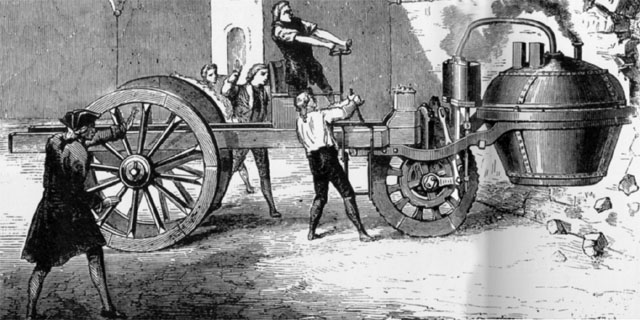
The first vehicle to move under its own power for which there is a record was designed by Nicholas Joseph Cugnot and constructed by M. Brezin in 1769. A replica of this vehicle is on display at the Conservatoire des Arts et Metiers, in Paris. I believe that the Smithsonian Museum in Washington D. C. also has a large (half size ?) scale model. A second unit was built in 1770 which weighed 8000 pounds and had a top speed on 2 miles per hour and on the cobble stone streets of Paris this was probably as fast as anyone wanted to go it. The picture shows the first model on its first drive around Paris were it hit and knocked down a stone wall. It also had a tendency to tip over frontward unless it was counterweighted with a canon in the rear. the purpose of the vehicle was to haul canons around town.

The early steam powered vehicles were so heavy that they were only practical on a perfectly flat surface as strong as iron. A road thus made out of iron rails became the norm for the next hundred and twenty five years. The vehicles got bigger and heavier and more powerful and as such they were eventually capable of pulling a train of many cars filled with freight and passengers.

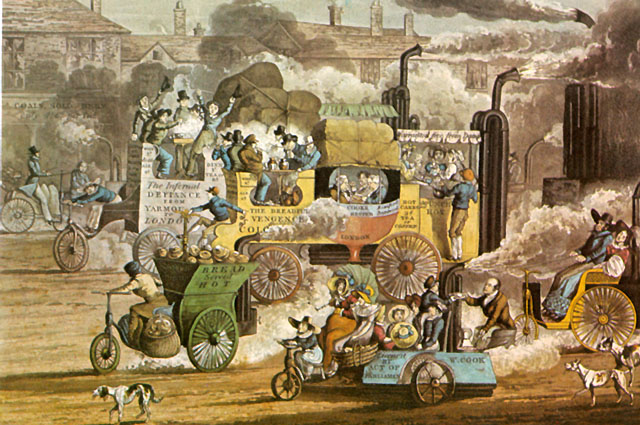
As the picture at the right shows, many attempts were being made in England by the 1830's to develop a practical vehicle that didn't need rails. A series of accidents and propaganda from the established railroads caused a flurry of restrictive legislation to be passed and the development of the automobile bypassed England. Several commercial vehicles were built but they were more like trains without tracks.

The development of the internal combustion engine had to wait until a fuel was available to combust internally. Gunpowder was tried but didn't work out. Gunpowder carburetors are still hard to find. The first gas really did use gas. They used coal gas generated by heating coal in a pressure vessel or boiler. A Frenchman named Etienne Lenoir patented the first practical gas engine in Paris in 1860 and drove a car based on the design from Paris to Joinville in 1862. His one-half horse power engine had a bore of 5 inches and a 24 inch stroke. It was big and heavy and turned 100 rpm. Lenoir died broke in 1900.

Lenoir had a separate mechanism to compress the gas before combustion. In 1862, Alphonse Bear de Rochas figured out how to compress the gas in the same cylinder in which it was to burn, which is the way we still do it. This process of bringing the gas into the cylinder, compressing it, combusting the compressed mixture, then exhausting it is know as the Otto cycle, or four cycle engine. Lenoir claimed to have run the car on benzene and his drawings show an electric spark ignition. If so, then his vehicle was the first to run on petroleum based fuel, or petrol, or what we call gas, short for gasoline.

Siegfried Marcus, of Mecklenburg, built a can in 1868 and showed one at the Vienna Exhibition of 1873. His later car was called the Strassenwagen had about 3/4 horse power at 500 rpm. It ran on crude wooden wheels with iron rims and stopped by pressing wooden blocks against the iron rims, but it had a clutch, a differential and a magneto ignition. One of the four cars which Marcus built is in the Vienna Technical Museum and can still be driven under its own power.

In 1876, Nokolaus Otto patented the Otto cycle engine, de Rochas had neglected to do so, and this later became the basis for Daimler and Benz breaking the Otto patent by claiming prior art from de Rochas.

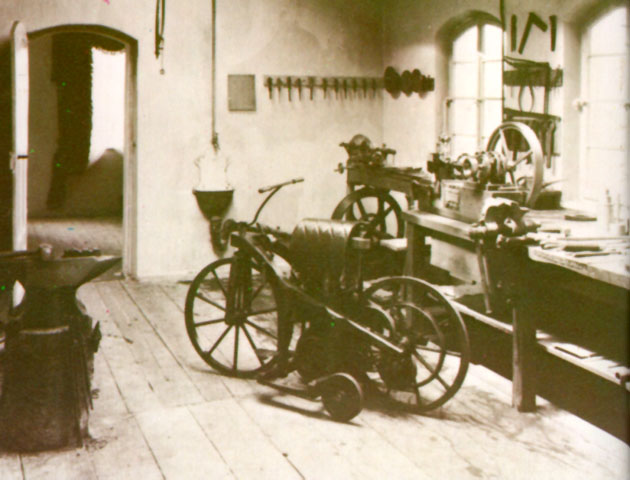
The picture to the left, taken in 1885, is of Gottllieb Daimler's workshop in Bad Cannstatt where he built the wooden motorcycle shown. Daimler's son Paul rode this motorcycle from Cannstatt to Unterturkheim and back on November 10, 1885. Daimler used a hot tube ignition system to get his engine speed up to 1000 rpm

The previous August, Karl Benz had already driven his light, tubular framed tricycle around the Neckar valley, only 60 miles from where Daimler lived and worked. They never met. Frau Berta Benz took Karl's car one night and made the first long car trip to see her mother, traveling 62 miles from Mannheim to Pforzheim in 1888.

Also in August 1888, William Steinway, owner of Steinway & Sons piano factory, talked to Daimler about US manufacturing right and by September had a deal. By 1891 the Daimler Motor Company, owned by Steinway, was producing petrol engines for tramway cars, carriages, quadricycles, fire engines and boats in a plant in Hartford, CT.

Steam cars had been built in America since before the Civil War but the early one were like miniature locomotives. In 1871, Dr. J. W. Carhart, professor of physics at Wisconsin State University, and the J. I. Case Company built a working steam car. It was practical enough to inspire the State of Wisconsin to offer a $10,000 prize to the winner of a 200 mile race in 1878.>

The 200 mile race had seven entries, or which two showed up for the race. One car was sponsored by the city of Green Bay and the other by the city of Oshkosh. The Green Bay car was the fastest but broke down and the Oshkosh car finished with an average speed of 6 mph.

From this time until the end of the century, nearly every community in America had a mad scientist working on a steam car. Many old news papers tell stories about the trials and failures of these would be inventors.

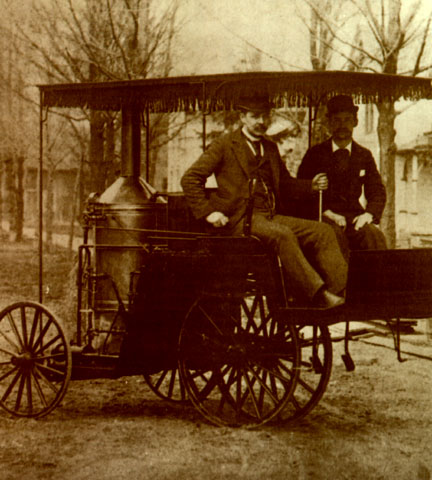
By 1890 Ransom E. Olds had built his second steam powered car, pictured at left. One was sold to a buyer in India, but the ship it was on was lost at sea.

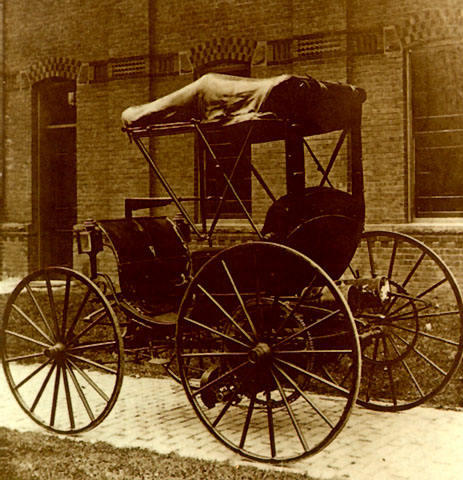
Running by February, 1893 and ready for road trials by September, 1893 the car built by Charles and Frank Duryea, brothers, was the first gasoline powered car in America. The first run on public roads was made on September 21, 1893 in Springfield, MA. They had purchased a used horse drawn buggy for $70 and installed a 4 HP, single cylinder gasoline engine. The car (buggy) had a friction transmission, spray carburetor and low tension ignition. It must not have run very well because Frank didn't drive it again until November 10 when it was reported by the Springfield Morning Union newspaper. This car was put into storage in 1894 and stayed there until 1920 when it was rescued by Inglis M. Uppercu and presented to the United States National Museum.

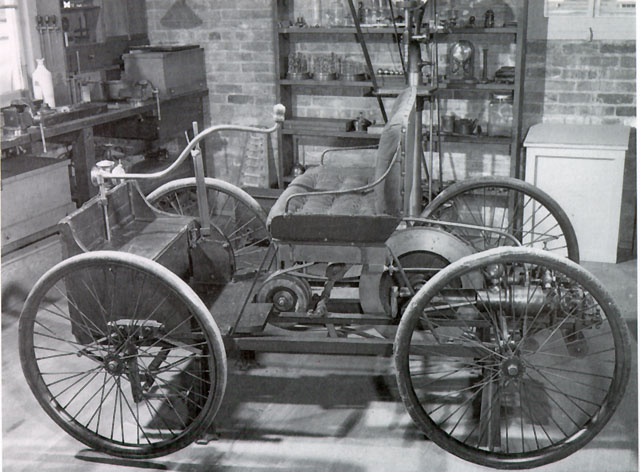
Henry Ford had an engine running by 1893 but it was 1896 before he built his first car. By the end of the year Ford had sold his first car, which he called a Quadracycle, for $200 and used the money to build another one. With the financial backing of the Mayor of Detroit, William C. Maybury and other wealthy Detroiters, Ford formed the Detroit Automobile Company in 1899. A few prototypes were built but no production cars were ever made by this company. It was dissolved in January 1901. Ford would not offer a car for sale until 1903.

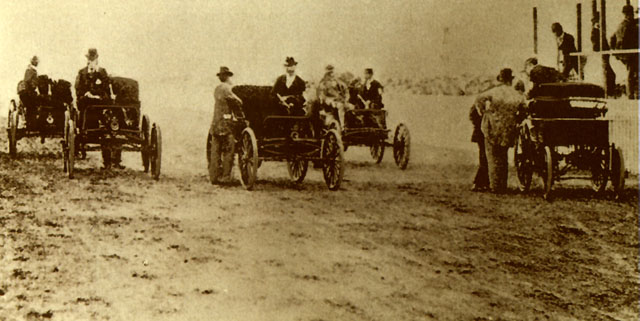
The first closed circuit automobile race held at Narragansett Park, Rhode Island, in September 1896. All four cars to the left are Duryeas, on the right is a Morris & Salom Electrobat. Thirteen Duryeas of the same design were produced in 1896, making it the first production car.

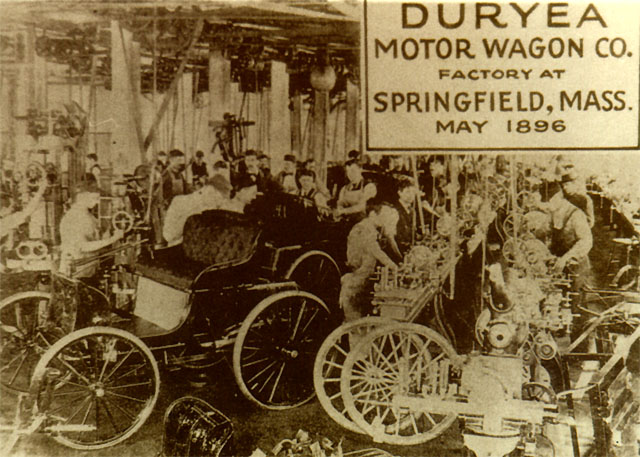
At left is pictured the factory with produced the 13 Duryeas. In 1898 the brothers went their separate ways and the Duryea Motor Wagon Company was closed. Charles, who was born in 1861 and was eight years older than Frank had taken advantage of Frank in publicity and patents. Frank went out on his own and eventually joined with Stevens Arms and Tool Company to form the Stevens-Duryea Company which was sold to Westinghouse in 1915. Charles tried to produce some of his own hare-brained ideas with various companies until 1916. Thereafter he limited himself to writing technical book and articles. He died in 1938. Frank got a half a million dollars for the Westinghouse deal and lived in comfort until his death in 1967, just seven months from his 98th birthday.

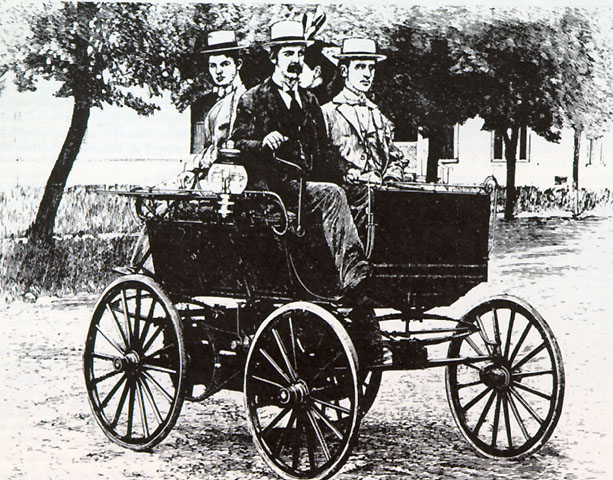
In this engraving Ransom Eli Olds is at the tiller of his first petrol powered car. Riding beside him is Frank G. Clark, who built the body and in the back are their wives. This car was running by 1896 but production of the Olds Motor Vehicle Company of Detroit did not begin until 1899. After an early failure with luxury vehicles they established the first really successful production with the classic Curved Dash Oldsmobile.

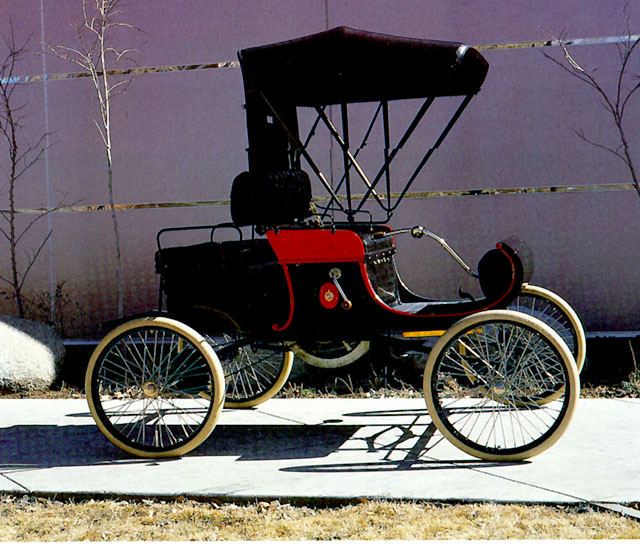
The Curved Dash Oldsmobile had a single cylinder engine, tiller steering and chain drive. It sold for $650. In 1901 600 were sold and the next years were 1902 - 2,500, 1903 - 4,000, 1904 - 5,000. In August 1904 Ransom Olds left the company to form Reo (for Ransom Eli Olds). Ransom E. Olds was the first mass producer of gasoline powered automobiles in the United States, even though Duryea was the first auto manufacturer with their 13 cars.

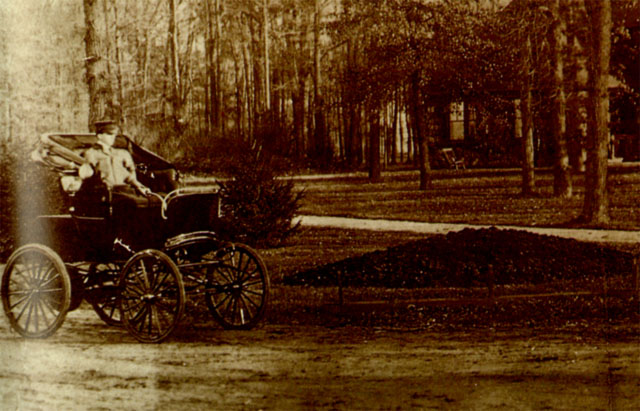
Ransom Olds produced a small number of electric cars around the turn of the century. Little is known about them and none survive. The picture at left is the only known picture of one of these rare cars. It was taken at was taken at Belle Island Park, Michigan. In 1899 and 1900, electrics outsold all other type of cars and the most popular electric was the Columbia built by Colonel Albert Augustus Pope, owner of American Bicycle Company.
an interesting footnote to the Olds electric.

J. A. Koosen and H. Lawson in a 1895 Lutzmann. This is typical of American design in the mid 1890's. It was truly a horseless carriage. Tiller steering, engine under the floorboards, very high center of gravity, not designed for road travel. Imagine climbing into one of these and trying to drive across town and around a few corners. Kind of scary, huh?

This Daimler of 1899 was owned by Lionel Rothchild. The European design is much advanced of the American designs of the same time. Gottlieb Daimler took part in the London-to-Brighton run in 1896 but died in 1900 at the age of 66 without ever meeting Benz. His German engines powered the automobile industries of Britain and France.

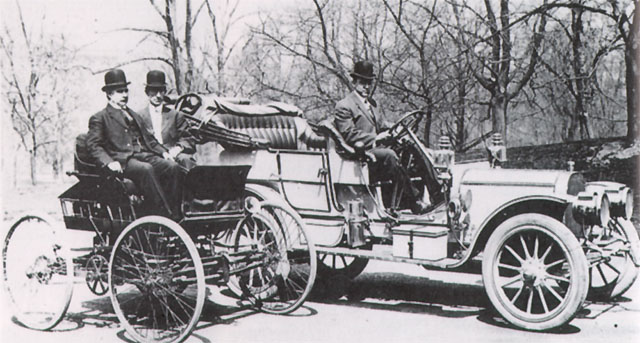
The 1908 Haynes in the back ground shows the rapid development of the petrol powered car when compared to the 1894 model in the foreground. Consider the present difference between a 1998 Tarus and the 14 year old 1984 Tarus. Some difference. Old man Haynes claimed to have build the 1894 car in 1893 but had no proof.

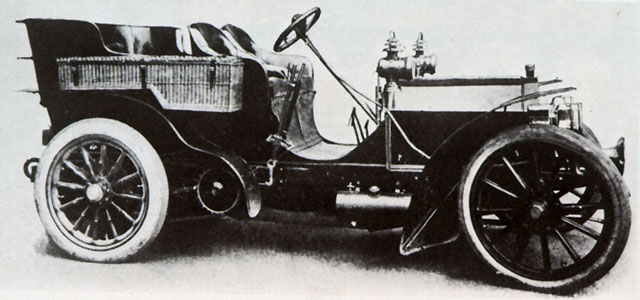
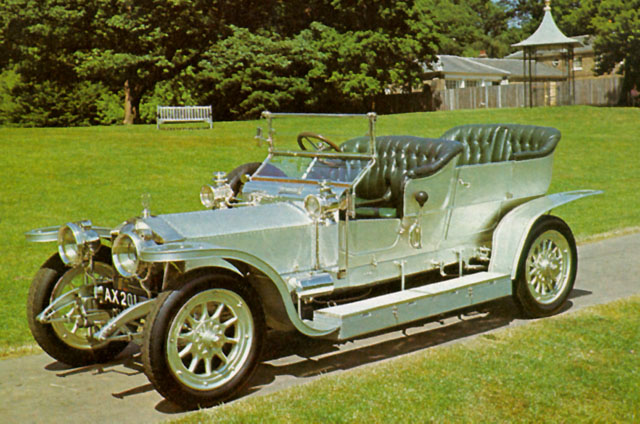
The Rolls Royce Silver Ghost of 1906 was a six cylinder car that stayed in production until 1925. It represented the best engineering and technology available at the time and these cars still run smoothly and silently today. This period marked the end of the beginning of the automobile.

Early Cars

Although it is Karl Benz who is credited with the first prototype (in 1885) of the modern car, the first self-propelled vehicle was invented more than 100 years earlier. However unlike the "Benz model", most of the machines designed during that period were steam-propelled.

The early car era nonetheless played an extremely significant role in the evolution of today's car.


1769 - NICOLAS CUGNOT

The very first self-propelled car was built in 1769, when Nicolas Cugnot, a French military engineer designed a steam powered road-vehicle.

The vehicle was built at the Paris Arsenal, and was used by the French Army to move cannons. It had three wheels with the engine in the front along with the boiler. While Cugnot's 'car' was capable of attaining speeds of upto 6 kms/hour, it was far too heavy and slow to be of practical use.


1771 - THE FIRST MOTOR ACCIDENT

Nicolas Cugnot who designed the first car in 1769 made another steam-driven vehicle two years later, also at the Paris Arsenal. The machine reportedly ran quite well, although on one occasion it ran into a wall, thus recording the world's first motor-accident. The vehicle may still be seen today in the Conservatoire Nationale des Arts et Metiers in Paris.


1807 - Francois Isaac de Rivaz

Issac de Rivaz (Switzerland), designed several successful steam-run cars towards the late 18th century. In 1807 he designed an "internal combustion engine".The engine was gas driven and used a mixture of hydrogen and oxygen to generate energy.

de Rivaz used this engine to develop a car, and the occasion was historic. This was the first vehicle to run on an internal combustion engine. In subsequent years Rivaz worked on his design, and in 1813 developed a 6 metres long car, weighing almost a ton.


1860 - Jean Etienne Lenoir

The early 19th century saw several different designs of the internal combustion engine (including that of de Rivaz, who also built a car based on his engine). However none of these early designs showed any degree of commercial success.

The first successful internal combustion engine was a two-stroke gas driven engine patented by Jean Joseph Etienne Lenoir of Belgium in 1860. In 1862 he built an experimental vehicle driven by his gas-engine, which managed to achieve a speed of 3 kms/hour. By 1865 around 500 of these engines were in use in Paris alone.


1865 - Red Flag Act

Progress in the development of cars saw stiff opposition from companies running horse-driven coaches. In the mid-1800s turnpike charges (similar to toll charges) for the "early cars" that which were then plying on road, were steeply hiked. These heavy and crudely built steam-driven vehicles must have badly damaged roads, and to some extent the increase was possibly justified.

The 'Locomotives on Highways Act' (Red Flag Act) was passed by the British Government in 1865. It was intended to regulate the use of heavy traction engines pulling large loads. The Act limited speeds to 6.4 kms per hour in the country and 3.2 in towns. It also required that every road locomotive must have three attendants - one to steer, one to stoke and one to walk 50 metres ahead of the vehicle, bearing a red flag, signaling the driver when to stop.

The Red Flag Act discouraged further developments of road-steam-vehicles. A subsequent Act passed 13 years later in 1878 did away with the red flag, but nevertheless the vehicle still had to be preceded by a man on foot to warn drivers of horse-driven coaches.


1876 - Nikolaus August Otto

The first practical "four-stroke" engine was patented by the Otto and Langen Company of Deutz, Germany.

A1-intake valve
A2-piston
A3-fuel/air mixture
A4-cylinder
B1-spark plug
B2-compressed mixture
C1-mixture ignites
D1-exhaust valve
D2-burned gases

Nikolaus Otto was a salesman with a grocer when he read of Lenoir's two-stroke gas-driven internal combustion engine. Otto started a workshop in Deutz near Cologne, supported by Langen in 1863. He had a model engine built and improved upon the gas engine, making it a practical power source. The four-stroke Otto Engine was invented in 1876, and a large number of engines were produced under the patent of Otto and Langen.

It was however, a German engineer named Gottlieb Daimler, who, carried out much of the development work on the engine. Daimler was at the time employed with Otto and Langen, and a substantial credit for the success is due to him.

The Linux laptops of 2009

The Linux laptop business represents a Chinese industry trying to serve a Western market and getting lost in the translation.

(Shown is the Dell Inspiron Netbook with a coffee mug, actual size.)

The Chinese like cheap, and they understand the cellphone business model. When Westerners look at the product, however, we want usable keyboards, acceptable screens and compatibility with the files we used last year.

The first generation of Linux laptops ran an Intel Atom chip set. They were underpowered, but Microsoft found a way to get Windows XP on them, at $3 per copy, then Windows 7, at an unknown price, so they are less of an adjustment.

The next generation of Linux laptops will run the same ARM system used in phones, which is why Chinese makers are looking to Android, a phone operating system, as their guide.

The total hardware cost is about $20. Everything else is the case and the bling. With a 1 GHz ARM chip and $200 price point Microsoft may be unable to compete. At least for now.

Ubuntu is able to go there, and announced an alliance with ARM last year. Its kit will sport a version of the Ubuntu Netbook Remix system first shown last year. A beta release of a new version shipped April 2.

Another route to a Linux laptop may be the Qualcomm Snapdragon system, shown running phones during CES. As I noted, at this point the only physical difference between a netbook and a phone is the case.

But there is an enormous difference in the buyers and their expectations. The result could be an historic disconnect between manufacturers and consumers.

All of which makes June’s CompuTex in Taiwan a very important show. It runs from June 2-6 and it’s already being called the show of the “all in one” PC.

What’s needed here are the views of Western users, not just manufacturers and OEMs. Last year’s product failed because it ignored this viewpoint.

No matter what a product’s price, its features must be acceptable to people like me. (That’s Ubuntu Netbook Remix on the left.)

Computer users are different from phone users. We have laps, we use 10 fingers, shaped in a position like piano players, and we demand not just file compatibility but a very short learning curve from the old laptop.

Those views may be carried by OEMs like HP, Dell, and Freescale, but there is another problem. Current PC distribution channels can’t handle a $200 PC. There is not enough margin there for even Fry’s to push the thing.

Cellphone channels see this as an opportunity but can you imagine getting a PC at a cellphone store, or a carrier shop? Free with a two-year contract is no bargain if you can’t get the thing to work and you can’t get support. The 20-minute sales cycle typical in a phone transaction (it’s cute, how does it work) won’t work for a PC.

The Apple iPhone bridged these retail models. The Apple Stores were used for initial demand, at a PC-like $595 price, and the second edition went to the cellphone stores, with demand pre-installed by the stores and new users.

That’s the kind of game Microsoft is looking to play with its Microsoft store, but it’s nowhere near those price points and the company has scant history moving hardware. (Mice don’t count.)

The result is that PCs are being designed and shipped, in million-unit lots, with almost no input from the consumers who will be expected to buy and use them, and with sales channels incompatible with the real market.

This could prove a disaster, one Linux may be unfairly blamed for. If Ubuntu and Android don’t “sell through” in 2009, next year’s more powerful chips could match up with a version of Windows 7, and a $400 price floor may then hold.

So time, for Linux, is of the essence. I’d love to go to CompuTex.